
Homestay and Airbnb Registration Rules by State in India (2026)
Goa, Kerala, Karnataka, Himachal, Uttarakhand, Rajasthan, Maharashtra and Delhi: who has to register, room limits, owner-residence rules, and everything that changed in 2026.
Published 2 November 2026
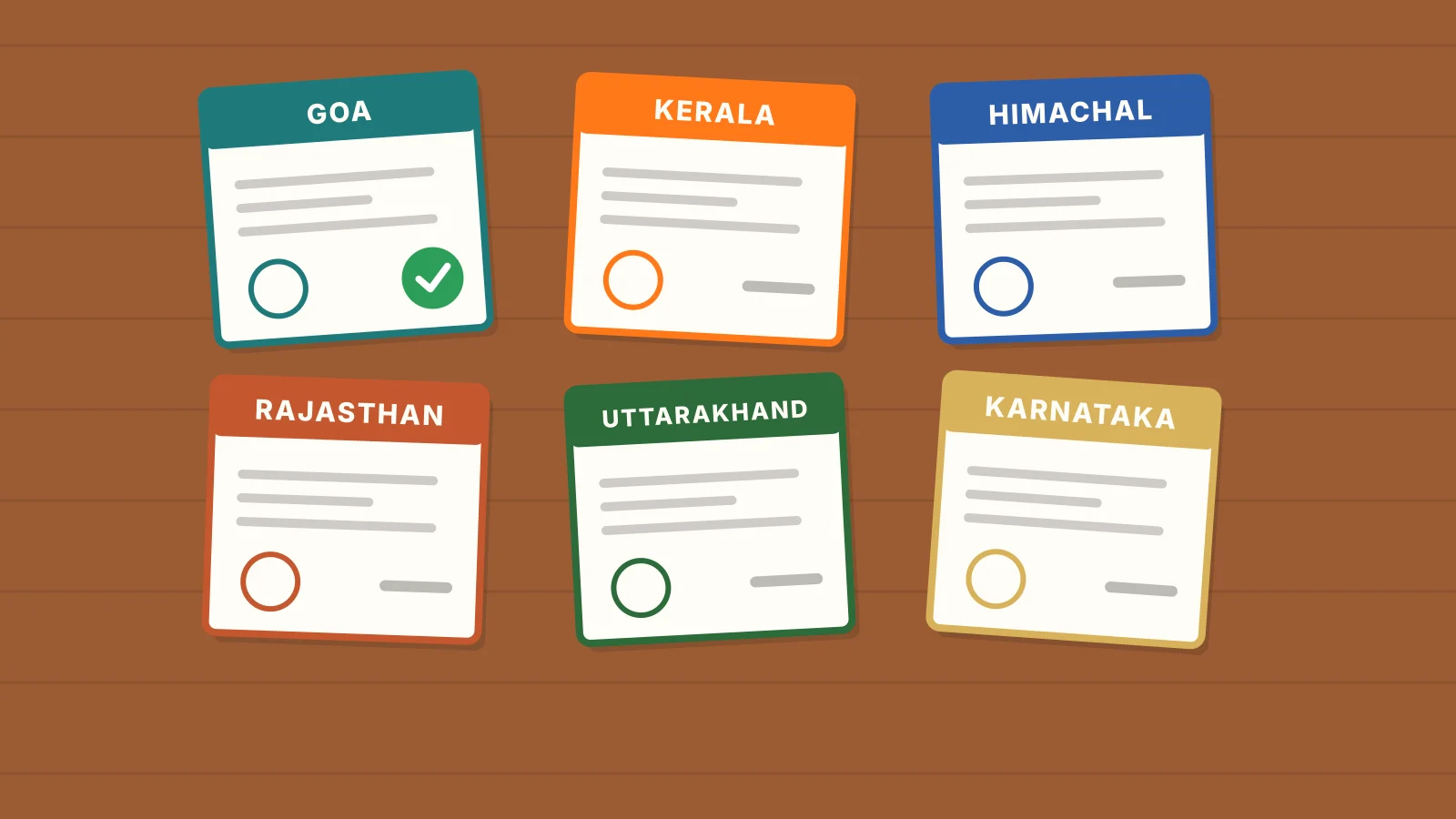
Quick answer: India has no national licence for homestays or Airbnb rentals. Each state sets its own rules, and most tourism states now require registration with the state tourism department before you take guests. The rules differ on three things that matter most: whether the owner has to live there, how many rooms you can let, and whether rented or leased homes qualify. 2026 brought big changes in Delhi, Rajasthan, Uttarakhand, Karnataka and Mumbai.
If you're planning to host on Airbnb, Wayzyy or any other platform, the first question isn't the platform. It's your state. A two-bedroom flat that can be registered in one state can't be registered at all in another. This guide sets out the rules in India's main homestay states as of late 2026, with what changed this year. For the national picture, see is Airbnb legal in India.
The rules at a glance
| State | Registration | Rule | Key conditions |
|---|---|---|---|
| Goa | Yes | Goa Registration of Tourist Trade Rules, 1985 (Category D) | 1–6 rooms. Registration number must be shown on listings since Jan 2026. Monthly Form XI on the TIME app. |
| Kerala | Yes (classification) | Kerala Tourism homestay classification | Owner must live there. Up to 6 rooms. Diamond, Gold or Silver. Valid 3 years. ₹3,750 fee. |
| Karnataka | Yes | Karnataka Tourism Trade Act, 2015; homestay guidelines 2025 | Registration drive in 2026. High Court asked for a fuller homestay policy in June 2026. |
| Himachal Pradesh | Yes | HP Home Stay Rules, 2025 | Owner-occupied independent houses only. Leased houses and flats banned. Fees by area and size. |
| Uttarakhand | Yes | Revised homestay scheme (May 2026) | Permanent residents only. Up to 8 rooms, 24 beds. 5-year registration proposed. |
| Rajasthan | Yes | Homestay (Paying Guest House) Scheme, 2026 | Up to 8 rooms, 24 beds. Owner, lessee or caretaker can run it. Guest register kept 7 years. |
| Maharashtra | Scheme-based; Mumbai licensing coming | Directorate of Tourism homestay scheme; BMC Short Term Rental policy | Tourist homes and homestays scheme extended to cities in 2025. Mumbai policy needs a BMC licence and society NOC. |
| Delhi | In transition | B&B scheme withdrawn June 2026 | Repeal bill passed. New policy drafted, not final. Fresh registrations on hold. |
Goa
Goa has the oldest and most enforced framework. Homestays, villas and rented apartments with one to six lettable rooms register under Category D of the Goa Registration of Tourist Trade Rules, 1985, through the Goa Online portal. Since 13 January 2026, the registration number must appear on the listing itself, and platforms can be told to remove listings without it. Registered hosts also upload monthly guest statistics (Form XI) on the TIME app by the 5th. Our Goa registration guide has the full process.
Kerala
Kerala Tourism says classification is mandatory for anyone starting a homestay. A government-appointed committee inspects the property and grades it Diamond, Gold or Silver. The rules are strict on what counts as a homestay: the owner and family must physically live in the house, leased or rented houses aren't eligible, and up to 6 rooms can be let. Classification lasts three years, and the application fee is ₹3,750 per homestay, paid online.
Karnataka
Homestays in Karnataka are registered by the Department of Tourism under the Karnataka Tourism Trade (Facilitation and Regulation) Act, 2015, with revised homestay guidelines issued in 2025. 2026 has been busy. In June, the Karnataka High Court, hearing a Kodagu homestay's licence cancellation, said the 2015 Act doesn't adequately cover safety, hygiene and security, and asked the state to frame a comprehensive homestay policy, suggesting a 10-point framework covering fire safety, food safety, guest ID checks and proportionate rules for small family homestays. By July, more than 500 homestays had applied for registration after the Tourism Commissioner urged unregistered operators to come forward.
Himachal Pradesh
The Himachal Pradesh Home Stay Rules, 2025 replaced the 2008 scheme. Every homestay must register with the Department of Tourism and Civil Aviation after a site inspection, and renew every one or three years. Fees depend on location and size: in municipal areas, ₹8,000 for one to three rooms and ₹12,000 for four to six, with lower fees in planning areas and villages. Apartments need a resident welfare association NOC.
In July 2025 the state tightened the rules: homestays can no longer run from leased houses, flats or partial units. Only independent houses owned by the applicant, verified in land records, qualify, and existing units had to re-register on a new portal.
Uttarakhand
Uttarakhand revised its homestay scheme in May 2026. It's now limited to permanent residents of the state who own and live in the building, though an authorised operator can run it under a registered agreement. The room limit went up from 6 to 8 rooms, capped at 24 beds, and registration is proposed to last five years with online self-renewal. A new category lets 8 to 10 homestays in a village cluster register together as a community unit.
Enforcement is real. In May 2026, Dehradun's administration cancelled 103 homestay registrations after inspecting 153 properties. Owners were found running them as commercial hotels, not living on site, lacking fire safety and food licences, overfilling rooms, and in some cases not filing Form C for foreign guests.
Rajasthan
The Rajasthan Homestay (Paying Guest House) Scheme, 2026, launched in February, went the other way on ownership. The old rule that the owner or a family member must live on the premises was removed: an owner, lessee or appointed caretaker can now run the unit. The limit rose from 5 to 8 rooms and 24 beds, every room needs an attached bathroom, and the unit must be in a residential complex. Hosts must keep guest registers for at least seven years and report foreign visitors. Applications go to local Tourism Department offices, or Tourist Reception Centres in rural areas.
Maharashtra and Mumbai
Maharashtra's Directorate of Tourism runs registration for tourist homes, homestays, tourism villas and tourist apartments, and extended it to urban areas in July 2025. Mumbai is about to get its own layer. The BMC has approved a Short Term Rental Licensing Policy that it says will be implemented shortly. It requires a BMC licence before listing, a no-objection from the society or other residents, an occupancy certificate for the building, police reporting of guests, and a licence charge of 1% of net revenue.
Mumbai housing societies can also restrict short-term rentals on their own. A Mumbai cooperative court ruled in March 2026 that letting a flat for short stays through web portals is commercial activity. More in our guide to Airbnb in a housing society.
Delhi
Delhi is in transition. After a fire at a Malviya Nagar B&B killed 21 people in June 2026 (the property was permitted six rooms but allegedly running 25, without a fire NOC), the government withdrew its Bed & Breakfast scheme, and the Assembly passed a bill repealing the 2007 B&B law. Existing certificates can continue where they don't conflict with the new framework, but fresh registrations are on hold. A draft B&B Policy 2026, proposing up to 8 rooms and 16 beds, mandatory fire compliance, CCTV and online registration, was still awaiting approval as of August 2026.
The national scheme
The Ministry of Tourism runs a voluntary Incredible India classification for bed-and-breakfast and homestay units. It can help with credibility, but it doesn't replace state registration, which is what decides whether you can legally operate.
Rules that apply everywhere
- Form C: every foreign guest must be reported to the immigration authorities within 24 hours, in every state. How Form C works.
- GST: registration once turnover crosses ₹20 lakh a year, with 5% or 18% depending on the nightly rate. GST for Airbnb hosts.
- Your building: a housing society can restrict short-term rentals even where the state allows them.
- Fire safety: after Delhi's fire, expect fire NOCs and inspections to be enforced harder everywhere.
Before you list
Check three things in order: your state's homestay rules, your building's rules, and your registration status. On Wayzyy, hosts are ID-verified and properties are checked before going live, and we're launching state by state, starting with Goa. If you're thinking about starting out, our guide to starting an Airbnb business in India covers the business side.
This guide summarises published rules and news reports as of November 2026. It isn't legal advice. State rules change often, so confirm with your state tourism department before you apply.
Frequently Asked Questions
Is homestay registration mandatory in India?+
Which states require the homestay owner to live on the property?+
Can I run a homestay in a rented or leased house?+
How many rooms can a homestay have in India?+
What happened to Delhi's bed and breakfast scheme?+
Do I need a licence to run an Airbnb in Mumbai?+
Is there a national homestay registration in India?+
Want to list your villa on Wayzyy?
Email us at hello@wayzyy.com - Wayzyy is launching soon in Goa.