
Why Villas in Goa Cost Different Prices on Different Platforms - The Fee Breakdown
Ever noticed the same villa in Goa priced differently on Airbnb, Booking.com, and other sites? Here is the honest breakdown of platform commissions, hidden fees, and how to book smarter.
Published 6 July 2026

A friend of mine sent me a villa in Assagao a few months ago while we were planning a Goa trip. It was one of those places that immediately makes you want to book it - a private pool, Portuguese-style interiors, enough space for eight people, and somehow still reasonably priced. Before anyone confirmed the booking, someone else in the group did what almost every traveller does today: "Wait, let me just check if it's cheaper somewhere else."
Within ten minutes we had the same property open across four different booking platforms.
That's when things became confusing.
The villa hadn't changed. The check-in date was exactly the same. The amenities matched, the photos matched, and even the reviews were from the same guests. Yet the total price looked different depending on where we checked. One platform showed a noticeably lower nightly rate, another looked more expensive until checkout, and a third landed somewhere in between.
At first, we assumed one of them hadn't updated their pricing. Then we thought maybe dynamic pricing had kicked in or one platform was running a temporary discount. It felt like one of those internet mysteries that nobody really understands.
The more we looked into it, though, the clearer it became that this wasn't about discounts at all. The biggest reason had nothing to do with the villa itself. It was the platform sitting between the guest and the host.
Once you understand how booking platforms actually make money, those price differences start making a lot more sense.
That's also why travellers today don't just compare villas anymore - they compare where they're booking them from.
Airbnb Changed the Industry, But It Doesn't Define It Anymore
It's impossible to talk about vacation rentals without talking about Airbnb.
For a lot of us, Airbnb completely changed what travel looked like. Before that, most trips started with searching for hotels. Staying in someone's home, renting a private villa with friends, or booking a beach house for a long weekend wasn't something people did as often as they do today. Airbnb made that mainstream, and it's hard to imagine the modern short-term rental industry without acknowledging the role it played.
But industries don't stop evolving just because one company helped create them.
Today, the idea of a housing stay is much bigger than Airbnb itself. People are booking villas through specialised luxury platforms, local property managers, boutique marketplaces, direct booking websites, and a growing number of host-focused platforms that are experimenting with different ways of doing business.
That's been driven by both sides of the marketplace.
Guests have become better at comparing prices before booking, while hosts have become much more aware of what different platforms actually cost them. If you speak to enough villa owners around Goa, you'll hear the same pattern over and over again. Most aren't loyal to a single platform - they list across multiple marketplaces because that's where travellers are searching.
One host we spoke to while researching this article laughed when we asked why the same villa looked cheaper elsewhere.
"People think we're changing prices every hour," he said. "Most of the time we're not. We're just working with platforms that all have different economics."
That one sentence probably explains the entire article better than any pricing table could.

How Platform Fees Flow from Guest to Host
Visual breakdown of where your booking money goes on traditional platforms vs. Wayzyy.
Guest Pays ₹10,000 for Stay
Airbnb / Booking.com Take Rate
• Platform Commission: -₹1,550 to -₹2,000
• Host Service Charge: Deducted
• Surprised Cancellation Rules: Applied
Flat Prepaid Subscription Rate
• Platform Commission: ₹0 (Zero %)
• Payment Gateway (UPI/Card): ~2%
• Host Protection & DigiLocker KYC: Included
So Why Does the Price Change?
The simplest answer is that every booking platform runs a different business.
Think about almost any marketplace you use regularly. Food delivery apps, ride-hailing apps, ticketing websites - they all need a way to make money after connecting buyers and sellers. Vacation rental platforms are no different.
Most of the larger booking platforms operate on a commission-based model. Every successful booking generates revenue for the platform, usually as a percentage of the reservation. That commission isn't necessarily something you see as a separate line item during checkout anymore, but it still exists in the economics of the booking.
Now put yourself in the shoes of someone who owns a villa in Goa.
You're already paying for housekeeping, electricity, Wi-Fi, pool cleaning, maintenance, gardening, staff salaries, linen, guest support, repairs, and everything else that goes into running a hospitality business. If the platform you list on also takes a percentage every time someone books your property, that becomes another operating expense.
Like any business owner, you eventually have to account for that cost.
Restaurants don't sell food without considering rent. Airlines don't price tickets without considering airport charges. Similarly, villa owners don't price their stays without thinking about the platforms they're using to reach guests.
That doesn't mean every host simply increases prices by the exact commission amount. Real pricing depends on demand, occupancy, seasonality, and competition. But platform costs are undeniably one of the variables that influence the final number a guest ends up paying.
And that's exactly why experienced travellers have quietly changed how they book holidays.
A few years ago, most people compared properties.
Today, they're increasingly comparing platforms as well.
Not because they're trying to save a few hundred rupees, but because they've realised that where you book can sometimes matter just as much as what you book.
That's also where the conversation around newer booking platforms begins. Rather than asking which platform has the most listings, travellers are starting to ask different questions. Which one is more transparent? Which one helps hosts build sustainable businesses? We compared these platforms in our guide on the best Airbnb alternatives in India for booking villas in Goa.
Those questions are shaping the next generation of vacation rental marketplaces, and before we compare them, it's worth understanding exactly how the biggest platforms earn their revenue and why the same villa can end up carrying a different price tag depending on where you find it.
How Does a Booking Platform Actually Affect the Price You Pay?
Let's go back to that villa in Assagao for a minute.
Imagine you're the owner, and after paying your staff, maintaining the property, covering utilities, cleaning, repairs, and everything else that comes with running a short-term rental, you've decided one thing:
"I want this booking to leave me with ₹10,000."
That's your target. Not because you're trying to maximise profit, but because that's the amount your business needs to stay sustainable.
Now comes the interesting part.
The moment you list that villa on different booking platforms, that ₹10,000 target starts looking very different.
Every platform has its own way of earning revenue. Some charge hosts a percentage every time someone books. Others charge for additional visibility or payment processing. And a newer generation of marketplaces has started experimenting with subscription-based or credit-based models instead.
From a guest's perspective, none of this is visible.
You simply see a nightly price.
But behind the scenes, the host is working backwards from what they need to earn.
That's why the same villa can quietly drift apart in price across different platforms, even though nothing about the stay itself has changed.
Airbnb's Pricing Changed Quietly. Most Travellers Didn't Notice.
For years, Airbnb followed a split-fee model.
Hosts paid a relatively small percentage, while guests saw a separate Airbnb service fee during checkout. It wasn't uncommon for travellers to reach the payment page and suddenly wonder why the final amount looked much higher than the nightly rate they had been comparing.
Towards the end of 2025, Airbnb began moving most listings to a different pricing structure. Instead of charging guests a separate service fee, the platform shifted to a host-only model where most hosts now pay around 15.5% of the booking subtotal. The guest sees a cleaner price upfront, while the platform deducts its fee from the host's payout.
For many travellers, that change went almost unnoticed.
The checkout experience became simpler, but the economics didn't disappear. They simply moved to the other side of the transaction.
If you're a host trying to run a profitable business, that platform fee becomes another operating expense alongside housekeeping, maintenance, electricity, salaries and property management.
One villa manager we spoke to in North Goa explained it in a way that immediately clicked.
"Guests stopped seeing the fee, but we didn't stop paying it."
That's probably the simplest way to understand what changed.
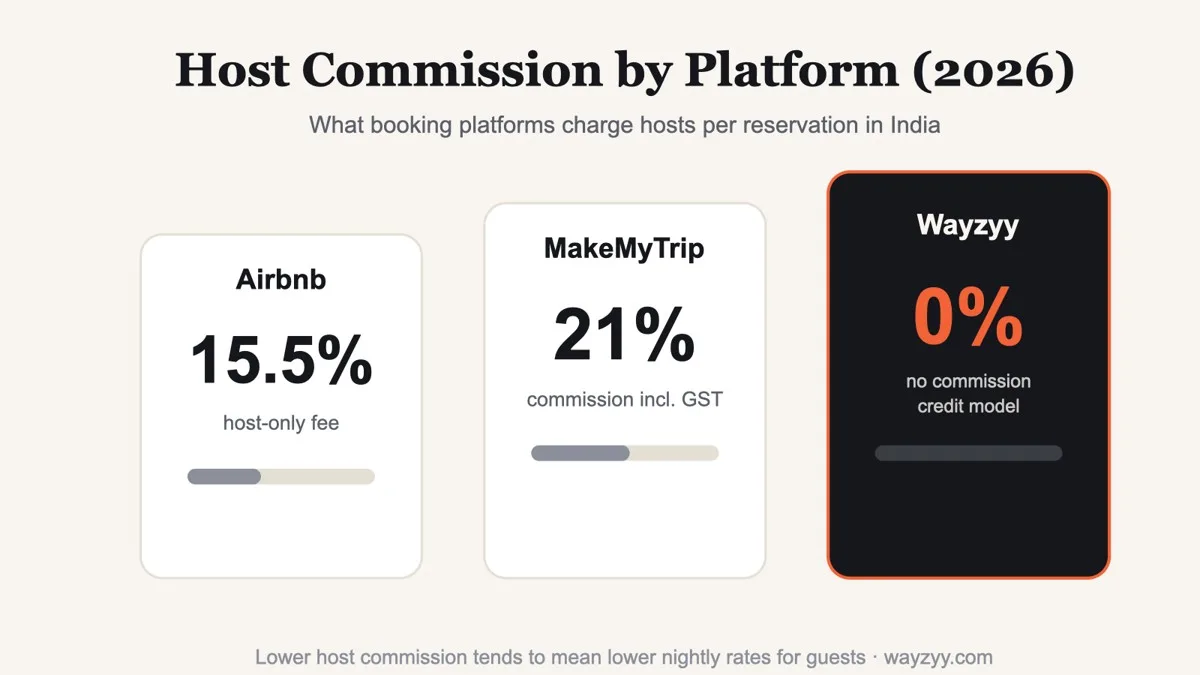
| Platform | How hosts are charged |
|---|---|
| Airbnb | 15.5% host-only commission per booking |
| Wayzyy | Prepaid credit model - no per-booking commission |
Hosting a villa? See your own numbers
Try our host earnings calculator to compare take-home earnings on Airbnb's commission vs Wayzyy's flat credit model for your actual booking volume.
Booking.com and MakeMyTrip Work Differently - But the Principle Is the Same.
Airbnb isn't the only company operating this way.
Booking.com has long worked on a host-commission model. Guests usually don't see a separate platform fee added during checkout, but accommodation providers pay a commission to list and sell through the platform. The exact percentage varies depending on the property, location and programmes the host participates in.
MakeMyTrip follows a similar idea, although its agreements are negotiated with property owners and can vary from one listing to another. On top of those commercial agreements, there are taxes and statutory deductions that hosts also have to account for as part of doing business.
None of this means these platforms are doing something wrong.
In fact, they're providing enormous value.
They bring millions of travellers to a host who may never have discovered that property otherwise. They invest heavily in payments, customer support, fraud prevention, marketing, international distribution and trust. That's exactly why so many hosts continue to list on them.
But it's also fair to recognise that every distribution channel comes with a cost.
Hosts simply have to decide whether that cost is worth paying.
So Where Does Wayzyy Fit Into This?
This is where newer marketplaces are starting to experiment with a different approach.
Instead of taking a percentage every single time a booking happens, some platforms are asking a different question:
What if the platform didn't need to earn from every reservation?
Wayzyy is one example of that thinking.
Rather than charging hosts a commission on every booking, the platform follows a credit-based model. Hosts simply recharge their account with credits based on the level of activity they expect, and bookings consume those credits over time instead of triggering another percentage deduction.
It's a fairly simple idea, but it changes the economics for everyone involved.
If a host isn't constantly accounting for another commission every time someone books, they have more flexibility in how they price their property. That doesn't automatically mean every villa becomes cheaper overnight, and it certainly doesn't guarantee a fixed percentage saving. Pricing still depends on seasonality, demand and the host's own strategy.
What it does mean is that the platform itself isn't introducing another commission layer into every reservation.
For guests, that's worth knowing.
If you're comparing the same villa across multiple websites, it makes sense to compare the final amount you'll actually pay, not just the first number that appears in search results (which you can estimate using our Goa trip budget guide). Sometimes they'll be almost identical. Sometimes they'll differ by only a few hundred rupees. And occasionally, especially on higher-value bookings, the difference can be much more noticeable because each platform follows a different commercial model.
That's ultimately why more travellers have started opening two or three tabs before booking.
They're no longer just comparing villas.
They're comparing the marketplaces behind them.
So, What's the Smartest Way to Book a Villa in Goa?
If there's one thing we've learnt while researching this article - and after speaking with hosts who manage properties across Goa - it's that there isn't a single "best" booking platform.
Every traveller values something different.
Some people want the biggest selection possible. Others care more about flexible cancellation policies. Families often prioritise verified reviews, while someone planning a month-long workation might care more about fast Wi-Fi, a quiet neighbourhood and whether there are cafés within walking distance.
That's exactly why comparing platforms has become part of planning the trip itself.
One host from Assagao said something that stuck with us while we were writing this.
"Guests spend hours comparing villas but sometimes only thirty seconds comparing where they're booking from."
It sounds obvious, but that's usually where the biggest difference comes from.
A booking platform isn't just a catalogue of properties. It's part of the overall experience. It determines how transparent pricing feels, how quickly issues are resolved, how cancellations are handled and, increasingly, how much flexibility hosts have in running their business.
That's why it's worth spending a few extra minutes comparing the booking experience - not just the villa.
Don't Compare the Nightly Rate. Compare the Final Booking Cost.
One mistake almost every first-time traveller makes is comparing the price that appears in search results.
That's rarely the number you actually pay.
Instead, compare the amount you're about to pay when you reach the checkout page.
Look at the taxes.
Check whether there's a cleaning fee.
See if there's a refundable security deposit.
Look for payment processing charges or additional service fees if they're applicable.
A villa that looks ₹1,000 cheaper at first glance can sometimes end up costing exactly the same - or even more - once everything is included.
The opposite can happen too.
That's why experienced travellers almost always compare the complete booking before making a decision.
Think About the Trip You're Planning.
The "best" platform depends on what kind of trip you're taking.
If you're travelling with fifteen friends for a birthday weekend, you'll probably care about large villas, private pools and flexible check-ins.
If you're visiting Goa with your parents, you're more likely to prioritise quieter neighbourhoods, accessibility and reliable support if something goes wrong.
Someone coming to Goa for a month-long workation will probably look for entirely different things - strong internet, a proper workspace, cafés nearby and a location that's peaceful enough to work from during the day. If you're still deciding where to set up, read our comparison on North Goa vs South Goa to find the right part for your trip.
The platform itself can't change the villa, but it often changes how easy it is to discover properties that match the kind of trip you're actually planning.
That's why newer marketplaces have started focusing on specific communities rather than trying to be everything for everyone.
Some specialise in luxury stays.
Some focus on boutique homes.
Some work exclusively with professionally managed villas.
Others, like Wayzyy, are starting by focusing on one destination first instead of spreading themselves across hundreds of cities. The idea is simple: understand one market deeply before trying to understand every market.
That local-first approach doesn't just help guests discover better stays. It also allows hosts to list with a platform that's designed around how hospitality actually works in Goa rather than applying the same formula everywhere.

A Better Marketplace Helps Both Sides.
One thing we realised while researching this piece is that travellers and hosts usually want the same thing.
Guests want honest pricing, great stays and responsive hosts.
Hosts want happy guests, repeat bookings and a business that's sustainable throughout the year.
Those goals aren't competing with each other.
In fact, they depend on each other.
A host who's constantly worrying about occupancy, pricing pressure or platform costs has less freedom to invest back into the property. On the other hand, a host who has more control over their business is far more likely to spend money on improvements that guests actually notice - better interiors, faster Wi-Fi, thoughtful amenities or simply providing a smoother experience from check-in to checkout.
That's one of the reasons we're starting to see more experimentation in how vacation rental marketplaces are built.
Instead of asking, "How do we earn more from every booking?" some platforms are asking, "How do we create an ecosystem where hosts and guests both come back?"
Wayzyy is one example of that shift.
Its credit-based model means hosts recharge their account instead of paying a commission every single time someone books. For hosts, that removes the feeling of giving away a percentage of every reservation. For guests, it creates the possibility of finding the same property at a more competitive price because there's one less recurring platform cost influencing the host's pricing decisions.
It's still an early platform, and that's important to acknowledge. You won't find the same inventory depth or years of reviews as platforms that have been operating globally for over a decade. But every established marketplace started somewhere, and new ideas are usually where industries evolve first.
The Bigger Picture.
The interesting thing is that this article was never really about Airbnb, Booking.com or Wayzyy.
It's about understanding that booking platforms are businesses with different models, and those models influence the prices you see.
Once you know that, comparing villas becomes much easier.
Instead of asking, "Why is this villa ₹2,000 cheaper here?" you'll start asking a much better question:
"Why does this platform price properties this way?"
And that's a question most travellers never think to ask.
One Last Thing Before You Book
If there's one thing we hope you take away from this article, it's that there's rarely a single "right" platform for booking a villa in Goa.
Airbnb has earned its reputation for a reason. It introduced millions of travellers to the idea that staying in someone's home could be just as memorable as staying in a hotel. Booking.com makes planning trips incredibly convenient, especially if you're already booking flights and hotels through the same ecosystem. Platforms like StayVista and SaffronStays have carved out their own niche by focusing on curated luxury villas and professionally managed experiences.
Each platform exists because different travellers value different things.
But the booking landscape is changing.
Travellers today are far more informed than they were five or six years ago. Before confirming a reservation, they'll compare reviews across platforms, look at the final checkout price instead of just the nightly rate, search for direct booking options and even spend time reading articles like this one to understand where their money is actually going.
Hosts are changing too.
For a long time, listing on one or two large marketplaces was enough to keep a property occupied throughout the year. Today, many hosts actively diversify where they list their villas. They understand that every platform reaches a slightly different audience and every platform comes with a different commercial model. Rather than depending entirely on one marketplace, they're choosing the channels that make the most sense for their business.
One villa owner in Siolim told us something that perfectly summed up where the industry seems to be heading.
"Five years ago, we were asking, 'How do we get listed on Airbnb?' Today we're asking, 'Where do our guests actually want to book?' That's a very different question."
That shift is creating room for newer ideas.
Instead of competing only on inventory, newer marketplaces are trying to compete on transparency, local knowledge and better economics for both sides of the transaction.
Wayzyy is one of those newer platforms.
Rather than taking a percentage from every reservation, it follows a simple credit-based model. Hosts recharge credits based on their booking activity instead of paying commission every time someone books. It's a different way of thinking about the marketplace, and while it's still early days, it reflects a broader shift happening across the short-term rental industry.
From a guest's perspective, that doesn't automatically mean every villa will always be cheaper. Property pricing still depends on the host, the season, local demand and plenty of other factors. What it does mean is that there's one less recurring platform cost influencing how hosts think about pricing. If you're already comparing two or three booking websites before making a reservation, it's another place worth checking - not because every booking will be dramatically cheaper, but because the underlying business model is different.
At the end of the day, that's probably the biggest takeaway from this entire article.
Don't compare platforms based only on their homepage.
Compare them based on the complete experience they create - for guests and for hosts.
Look at the final amount you'll actually pay. Read recent reviews. Compare cancellation policies. Think about the kind of trip you're planning. And if you're travelling with a larger group, don't hesitate to open a few extra tabs before making a decision. Spending five extra minutes comparing platforms can sometimes save far more than spending another hour searching for a different villa.
After all, the goal isn't to find the cheapest booking website.
It's to find the best value for the trip you're planning.
Frequently Asked Questions
Why does the same villa in Goa have different prices on different booking platforms?
In many cases, the property itself hasn't changed - it's the platform behind it. Every booking platform follows a different business model. Some charge hosts a commission on every reservation, while others use subscriptions, promotional programmes or alternative pricing structures. Hosts consider those costs alongside maintenance, staff salaries and operational expenses when pricing their properties, which is why the same villa can appear at different prices across different websites.
Is Airbnb more expensive than Booking.com in Goa?
Not necessarily.
Sometimes Airbnb will have the better price. Sometimes Booking.com will. The difference depends on the host's pricing strategy, platform-specific promotions, taxes and how each platform structures its commercial model. Rather than assuming one is always cheaper, compare the final checkout amount before making a booking.
Why do prices increase during checkout?
The nightly rate is only one part of the total cost. Depending on the property, your final amount may include GST, cleaning charges, security deposits or other applicable fees. That's why it's always worth comparing the total payable amount rather than only the first price shown in search results.
Are newer booking platforms safe to use?
The answer depends on the platform.
Before booking anywhere, check guest reviews, cancellation policies, customer support options and payment security. Established platforms naturally have a longer track record, while newer platforms may offer different advantages such as local expertise or alternative pricing models. As with any online booking, it's worth doing a little research before confirming your stay.
What makes Wayzyy different from other booking platforms?
Wayzyy follows a different approach to how it works with hosts. Instead of charging a commission every time a booking happens, hosts use a credit-based system where they recharge credits as needed. The idea is to give hosts more flexibility while creating a transparent booking experience for guests. Since it's a newer Goa-focused marketplace, its inventory is still growing, but it's part of a broader shift towards host-first booking platforms.
What's the smartest way to book a villa in Goa?
Start by deciding what matters most for your trip. If you're travelling with family, look beyond price and check amenities, cancellation policies and recent reviews. If you're planning a workation, prioritise internet quality and location. Most importantly, compare the final booking amount across a couple of trusted platforms before confirming your reservation. A few extra minutes of comparison can often help you make a much more informed decision.
Want to list your villa on Wayzyy?
Email us at hello@wayzyy.com - Wayzyy is launching soon in Goa.