
The Real Cost of Airbnb's 15.5% Fee Isn't 15.5%
An honest analysis of Airbnb's 15.5% simplified host fee, its ripple effects on pricing competitiveness in India, and how hosts can build resilient businesses.
Published 9 August 2026

The conversation around Airbnb's new fee structure has largely focused on one number - 15.5%. But the percentage itself isn't the biggest issue. What matters is everything that happens because of it.
Hosts who decide to absorb the additional fee will see their margins shrink. Those who increase their prices to recover the cost risk becoming less competitive. Neither option is particularly attractive, especially in markets like India where guests often compare properties within very specific budget ranges.
Why Indian Hosts Will Feel This More Than Most Markets
For many hosts in countries like the US, increasing prices by 10–15% may not dramatically change their competitiveness. In India, however, every price increase can have a noticeable impact on bookings because guests are often far more price-sensitive and compare dozens of similar properties before making a decision.
Take Goa as an example. A host isn't just paying Airbnb's commission. They're also covering housekeeping, laundry, maintenance, electricity, internet, staff salaries, property management, repairs, and local taxes. During peak seasons like Christmas and New Year, these costs are easier to absorb because demand is naturally high. During the monsoon or shoulder season, however, margins are already much thinner.
Now add an additional platform fee into that equation. Hosts are left with two choices:
The first is to absorb the additional cost themselves. While this keeps the listing price attractive, it also reduces profitability. For independent hosts managing one or two properties, that might mean delaying maintenance or earning significantly less from each booking.
The second option is to increase the nightly rate. That sounds simple until you look at how guests actually search. Most guests don't browse every property available in Goa. They start with a budget. Someone searching for stays under ₹10,000 per night is unlikely to ever see a villa that's now priced at ₹11,500, even if that increase happened solely because the host was trying to recover higher Airbnb host fees.
This creates an entirely new competitive landscape. A villa that previously competed with similar ₹10,000 properties is suddenly competing with premium listings that have always been in the ₹11,000–₹12,000 range. At the same time, the original ₹10,000 price bracket is now filled with newer or lower-priced competitors.
In other words, increasing prices doesn't just change your revenue - it changes who you're competing against. This is one of the most overlooked consequences of changes in Airbnb pricing, and it's particularly relevant in seasonal markets like Goa, where small pricing differences can significantly influence booking decisions.
For hosts managing multiple properties, the challenge becomes even bigger. A small reduction in occupancy or a slight drop in average nightly rates isn't limited to a single booking - it affects cash flow across the entire portfolio. This is why many experienced hosts are no longer looking at this as just another pricing update. They're looking at it as a business decision that could reshape how they price properties, diversify bookings, and reduce dependence on a single platform.
The Ripple Effect Has Already Started
The impact of Airbnb's new fee structure isn't limited to higher platform fees. It's already beginning to influence how hosts, co-hosts, and property managers negotiate their businesses.
One discussion that recently caught our attention perfectly illustrates this. A host shared that after Airbnb introduced the 15.5% host-only fee model, their co-host wanted to increase their commission from 26% to 32%. The host argued that doing so would mean absorbing both Airbnb's additional fee and the higher co-host commission, significantly reducing their own earnings.
Whether the co-host's request is reasonable isn't really the point. The bigger takeaway is that a single platform policy change is now affecting agreements between business partners who had already settled on a revenue-sharing model. This isn't an isolated pricing problem anymore - it's becoming an operational one.
The same conversations are happening around property management companies, cleaning services, and revenue managers. Everyone in the hosting ecosystem is asking the same question: Who should absorb the additional cost? Should the host accept lower profits? Should the guest pay more? Should co-hosts reduce their margins? Or should everyone share the burden?
There isn't a universal answer, which is exactly why this change has created so much uncertainty within the hosting community.
Another challenge is that pricing isn't something hosts can simply adjust overnight. Many guests have already saved properties to their wishlists, compare prices over several weeks, or return to the same villa every year. A sudden increase in pricing can easily be interpreted as the host becoming more expensive, even though the underlying economics of the booking have changed.
For hosts managing multiple properties, making pricing decisions has also become more complex. Every property sits within a specific pricing range. Increasing rates to recover the new Airbnb fees for hosts doesn't just affect profitability - it changes where that listing appears in the market and which properties it competes against.
This is why many experienced hosts are no longer asking, "How do I recover 15.5%?" They're asking a much bigger question: "How much control do I really have over my business if a single platform decision can change my pricing strategy overnight?"
That question goes far beyond Airbnb. It's about long-term sustainability. As more hosts recognize the risks of relying on a single marketplace, many are beginning to diversify - listing on multiple platforms, encouraging repeat direct bookings, and exploring alternatives that give them greater control over pricing and their relationship with guests.
The 15.5% Price Hike POV: Why Guest Rates Are Rising
Let's look at the actual math and psychology of this shift. Previously, Airbnb split its service fees: hosts paid a small 3% commission, and guests paid a 14% to 16.5% service fee visible at checkout. Under the new "Simplified Pricing" structure, the guest service fee at checkout is eliminated (showing ₹0), but the host is charged a flat 15% to 15.5% fee directly on the payout subtotal.
Statistically and economically, hosts cannot simply absorb this 15.5% deduction without running their rental businesses at a loss. To protect their net payouts, hosts are mathematically forced to raise their base nightly rates by roughly 15.5%.
For the guest, the property hasn't changed, but it now appears 15% more expensive upfront in search results. This pushes listings into higher pricing tiers where they must compete with more luxurious properties, often leading to a drop in occupancy.
How Airbnb's 15.5% Shift inflates your rates
Adjust the slider to your desired Net Take-Home Payout per night. Watch how your base listing price must inflate to preserve your margins.
Comparison Matrix: The Split-Fee vs. Simplified Pricing Math
To make the impact clear, let's compare what happens when a host wants to earn a net payout of ₹9,700 on a booking:
| Pricing Metric | Split-Fee Model (Old 3% Host) | Simplified Model (New 15.5% Host) | The Real Impact on Pricing |
|---|---|---|---|
| Nightly Base Rate set by Host | ₹10,000 | ₹10,000 | Hosts keeping base rate same lose ₹1,250 on payout. |
| Guest Service Fee at Checkout | ~₹1,400 (Paid by guest) | ₹0 (Paid by guest) | Checkout looks "free" to guests, but base rate is inflated. |
| Platform Fee Deducted from Host | ₹300 (3% host fee) | ₹1,550 (15.5% host fee) | Host payout drops from ₹9,700 to ₹8,450. |
| Adjusted Rate (To Keep Original Payout) | ₹10,000 | ₹11,500 (+15.5% Hike) | Guest pays more upfront; property shifts to higher price tier. |
The Indian Context: High Fees Meet Lower ADRs
In the Indian market, this fee consolidation has a distinct psychological impact on guests. Under the old split-fee structure, guests understood that a portion of their payment went to the platform for booking services. With Simplified Pricing, the entire service fee is rolled into the base nightly rate. Because these platform fees are no longer separated, guests often perceive that the host is directly overcharging them, which statistically leads to lower review scores and drives more hosts to sell offline.
This perception gap is especially challenging because of local market economics. The average Indian Airbnb ADR (Average Daily Rate) ranges from ₹2,500 to ₹3,500. At this rate, a 15% platform commission is a significant chunk of money percentage-wise. Raising rates to recover it makes listings uncompetitive, while absorbing it directly threatens the viability of smaller homestays.
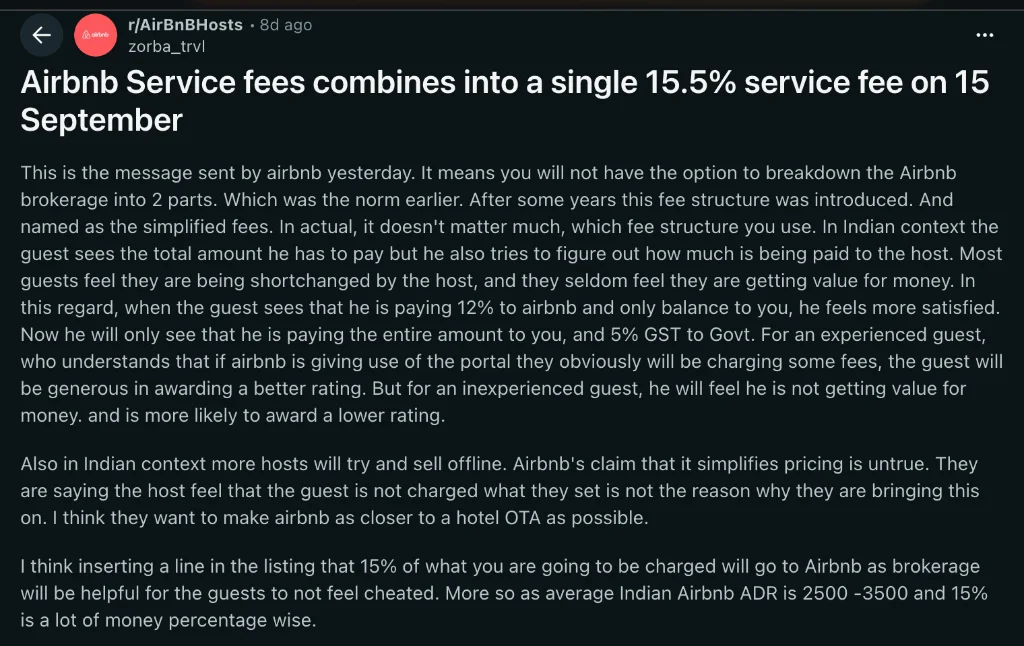 Indian hosts discussing the psychological impact of fee integration on average ADRs
The Support Gap: High Commissions Without Host Protection
This structural dependence is made worse by a lack of platform accountability when real disputes occur. For hosts, paying a premium 15.5% commission should theoretically guarantee a high level of customer protection and mediation. In reality, host communities are filled with stories of arbitrary refund decisions and loophole exploitation where the platform offers little meaningful support.
In recent discussions on host forums, property owners describe cases where guests stay for multiple days and receive a complete refund on trivial pretexts (such as 'no toilet paper') after the host refuses unreasonable demands, such as free catering for large groups. Because there is a clear gap in accountability, hosts carry all the operational risk while paying high fees to a platform that offers them zero recourse.
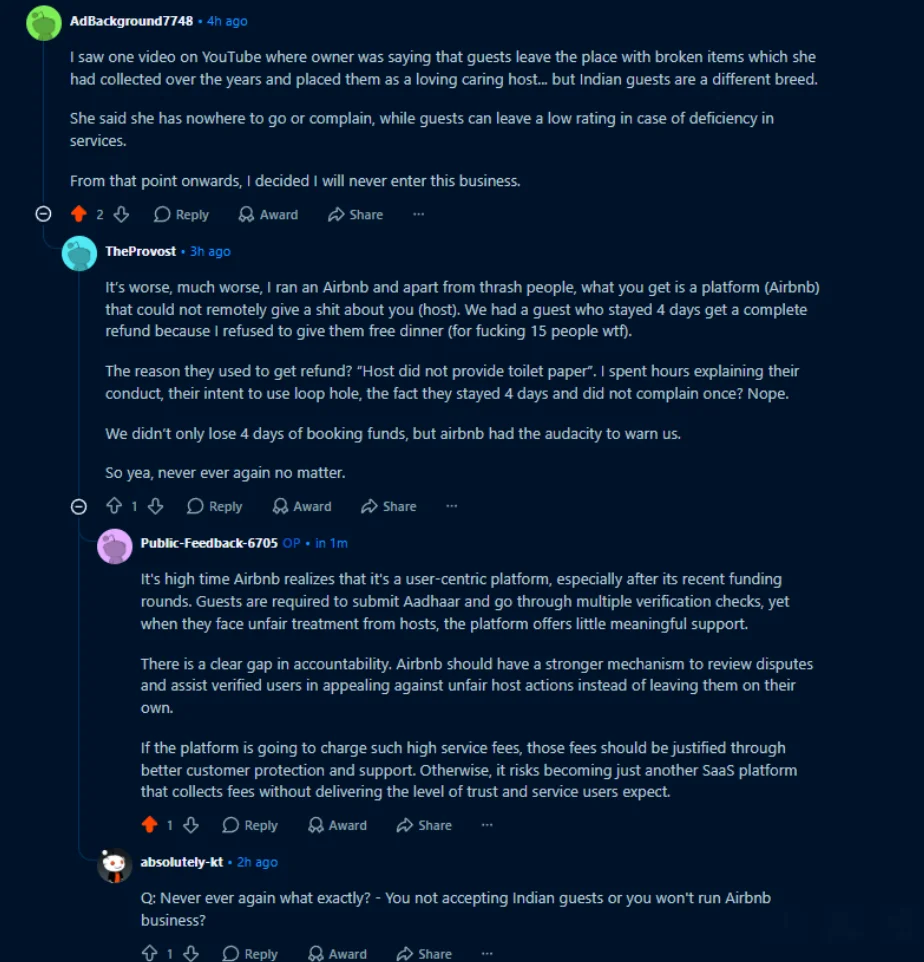 Hosts sharing experiences of platform disputes and arbitrary payout reversals
Why We Believe Hosts Need More Than One Platform
The biggest lesson from this entire discussion isn't that Airbnb made the wrong decision. Every platform has the right to evolve its pricing model based on its own business objectives.
The bigger lesson is what happens when thousands of businesses depend almost entirely on a single platform. When one company changes its commission structure, hosts immediately have to rethink their pricing strategy. If search algorithms change, hosts adapt again. If fees increase, nightly rates change. If visibility drops, bookings are affected. That's a lot of influence for one platform to have over an entire business.
Over the last few months, we've spoken with and onboarded more than 100 hosts across India. While every host has a different property and a different pricing strategy, one concern kept coming up repeatedly:
"We don't want to depend on just one platform anymore."
Not because Airbnb doesn't work. It clearly does. But putting all your bookings, pricing, and visibility in one place means every policy update has an immediate impact on your business.
That's one of the biggest reasons we started building Wayzyy. Our goal isn't to ask hosts to leave Airbnb or stop listing on other OTAs. In fact, we believe most professional hosts will continue using multiple platforms because that's simply how modern hospitality works.
What we're trying to build is another distribution channel - one where hosts have greater control over their pricing, can build direct relationships with guests, and aren't forced to rethink their business every time a marketplace changes its rules.
For guests, this also creates a better experience. As hosts increase prices to recover higher platform fees, guests inevitably end up paying more. By giving hosts additional ways to reach travelers, platforms can compete on value rather than simply passing higher costs down the chain.
Healthy competition benefits everyone:
- Hosts gain more control over their businesses.
- Guests get more choice and better pricing.
- The market becomes less dependent on decisions made by any single platform.
Ultimately, that's the future we believe the Indian vacation rental industry should move toward - not replacing one platform with another, but creating an ecosystem where hosts have options, guests benefit from genuine competition, and no single policy change can reshape the economics of an entire industry overnight.
Calculate Your True Earning Leak
See how much you lose to Airbnb's 18% fees versus Wayzyy's flat-rate credits.
Traditional commission models charge a flat rate that scales indefinitely with your bookings.
No commission deducted from individual payouts. Unlock booking volumes with simple credits.
₹80,000 / Month
So, What Should Hosts Do Now?
There isn't a single strategy that works for every host. A beachfront villa in North Goa has a very different pricing strategy than a homestay in Jaipur or a cottage in Himachal. But one thing is becoming increasingly clear: pricing can no longer be something you set once and forget.
If you've been relying on the same nightly rates for months, now is the right time to revisit them. Don't increase prices simply because platform fees have changed. Look at your occupancy, operating costs, local competition, and the value your property offers. The goal isn't to recover every rupee overnight - it's to build a pricing strategy that remains sustainable over the long term.
This is also a good time to rethink where your bookings come from. If nearly all of your reservations depend on a single platform, every policy update - whether it's commissions, search rankings, cancellation rules, or pricing models - has a direct impact on your business. Diversifying doesn't mean leaving Airbnb. It means making sure Airbnb isn't your only source of guests.
Many experienced hosts already follow this approach. They'll list across multiple OTAs, encourage repeat guests to book again, maintain their own website or social presence, and invest in channels they control. The objective isn't simply to increase bookings - it's to reduce dependency.
The Real Cost of the 15.5% Fee Isn't 15.5%
Airbnb's move to a 15.5% host-only fee will eventually become another milestone in the company's history. Like every platform update before it, hosts will adapt. The more interesting story isn't about the fee itself - it's about what this change reveals.
It highlights how quickly the economics of a hosting business can shift when one platform updates its policies. A decision made in a boardroom can influence pricing strategies, guest expectations, occupancy targets, and even the profitability of thousands of independent hosts across different markets.
For Indian hosts, where margins are often tighter and pricing is highly competitive, those effects are even more pronounced. Recovering an additional cost isn't simply a matter of increasing nightly rates. Every adjustment changes how a property is positioned, who it competes with, and how guests perceive its value.
That's why the conversation shouldn't stop at "How do I recover the extra 15.5%?" A better question is: "How can I build a hosting business that's resilient to changes like this?"
The answer will look different for every host. Some will refine their pricing strategy. Others will invest in repeat guests, explore direct bookings, or expand to additional marketplaces. Most will probably do a combination of all three. What matters is having options.
The strongest hosting businesses aren't defined by the platform they list on. They're defined by how well they adapt when the market changes. And if there's one lesson from Airbnb's latest pricing update, it's that having more control over your business has never been more valuable.
Frequently Asked Questions
Want to list your villa on Wayzyy?
Email us at hello@wayzyy.com - Wayzyy is launching soon in Goa.