
The Hidden Costs of Running an Airbnb (What Nobody Tells New Hosts)
Before you welcome your first guest, discover the true hidden costs experienced hosts face - from complex damage claims and rating pressures to scaling platform commissions and forced policy changes.
Published 2 August 2026
The Hidden Costs of Running an Airbnb (What Nobody Tells New Hosts)
Search for videos about starting an Airbnb and you'll notice the same story repeated over and over again.
Find a property.
Decorate it beautifully.
Upload professional photographs.
Start getting bookings.
At first glance, it really does look that simple.
That's probably why thousands of people enter the short-term rental business every year believing they'll be managing guests, collecting payments and watching the business grow month after month.
The reality usually starts changing after the first few bookings.
Guests don't always arrive exactly when expected. Last-minute cancellations happen. A plumbing issue somehow appears just a few hours before check-in. Someone accidentally stains expensive linen, another guest leaves behind a damaged appliance and sooner or later you discover that running a vacation rental has far more in common with operating a hospitality business than earning passive income.
Over the last year, while building Wayzyy and speaking with independent hosts, we've realised something interesting.
Very few people regret starting a vacation rental.
What they regret is how unprepared they were for everything that came after listing their property.
Curious to see whether our conversations reflected a wider pattern, we spent time reading through discussions on r/Airbnb_Hosts, one of the largest online communities where hosts openly share their day-to-day experiences. The conversations weren't dominated by questions like "How do I get more bookings?" or "How much revenue can I make?"
Instead, hosts were discussing problems that almost never appear in YouTube tutorials.
How do you deal with an unfair review?
What happens if a guest damages the property?
Why does a reimbursement claim require so much documentation?
How do you respond when support gives conflicting answers?
What should you do when a guest threatens a bad review to get a refund?
Those are the questions that repeatedly surfaced.
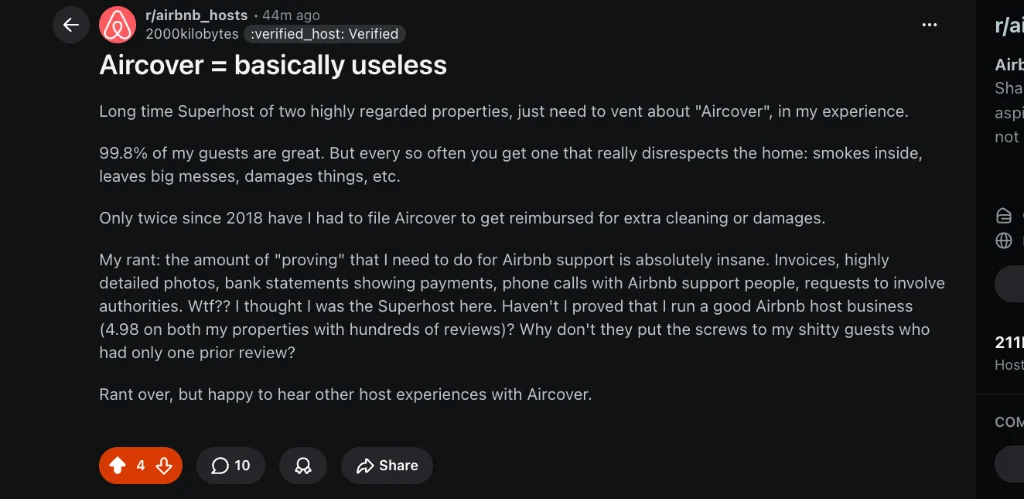
One discussion that particularly caught our attention came from a long-time Superhost who explained that recovering money through AirCover wasn't nearly as straightforward as the marketing made it sound (read the original AirCover thread on Reddit). According to the host, the claim required invoices, payment records, photographs and multiple rounds of communication before it could move forward. Other experienced hosts joined the discussion with similar stories, describing how the process often became frustrating when they were already dealing with the aftermath of guest damage. The issue wasn't simply the damage itself - it was the amount of time and effort required after it happened.
Another thread focused on something even more surprising.
Support.
Hosts weren't asking for special treatment.
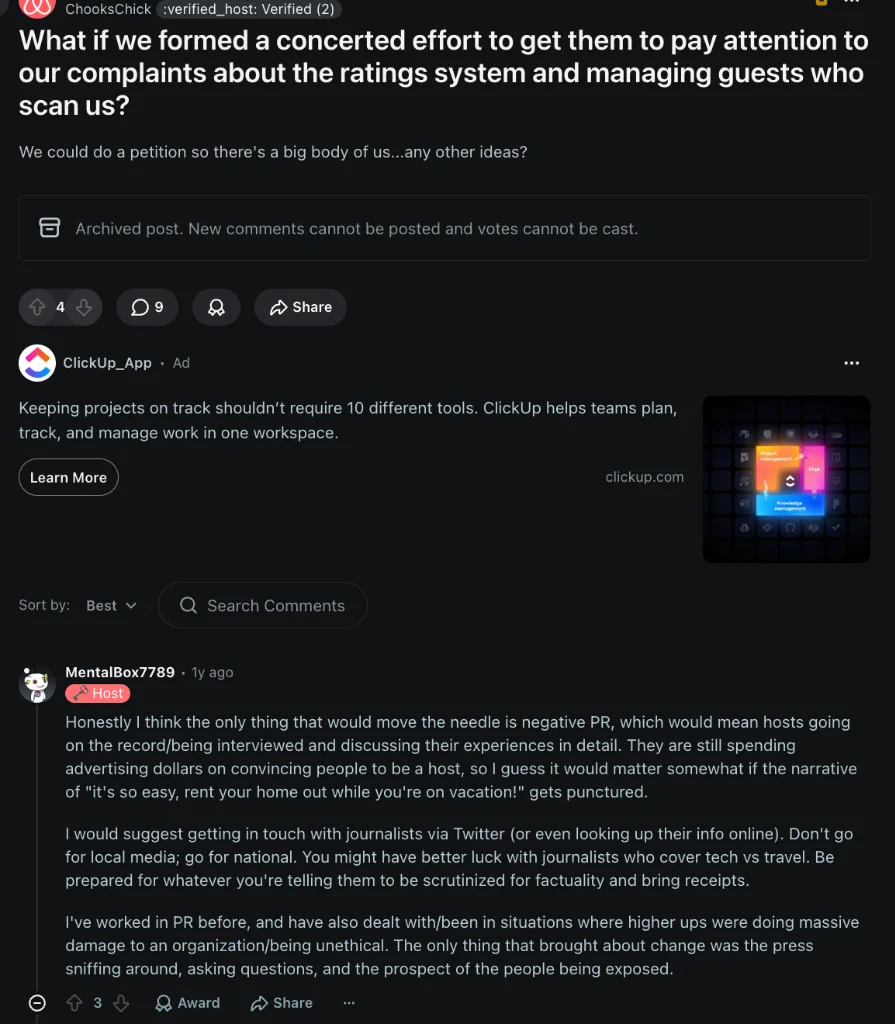
Most were simply looking for quicker resolutions, consistent communication and a process they could rely on when something went wrong. In one recent discussion, several hosts even began talking about organising collectively because they felt their concerns around support quality and host protection weren't receiving enough attention (view the community support thread on Reddit). Whether every host shares that opinion or not, the conversation itself highlights an important reality - many independent hosts want a platform that listens to them as much as it listens to guests.
Reading hundreds of these stories made us step back and ask a different question.
What if the biggest challenge in hosting isn't attracting bookings?
What if it's everything that happens after the booking has already been confirmed?
That question eventually became one of the foundations behind Wayzyy.
Instead of starting with features, we started with host frustrations.
Why should a good host worry that one unfair review could undo years of consistently excellent hospitality?
Why should identity verification feel like an afterthought when trust is the foundation of every booking?
Why should property owners continue giving away a significant percentage of every reservation when those same funds could be reinvested into better staff, better maintenance and a better guest experience?
Every decision we made while building Wayzyy came from those conversations.
This article isn't here to convince you that hosting is a bad business.
Far from it.
We believe short-term rentals remain one of the most exciting opportunities in hospitality today.
Our goal is much simpler.
Before you welcome your first guest, you deserve to know about the challenges experienced hosts wish someone had warned them about. Understanding those realities won't stop you from becoming a host - it'll help you become a better one from day one.
The Cost You Can't Add to a Spreadsheet
Money isn't always the most expensive part of running a vacation rental.
Sometimes it's the uncertainty that comes with every booking.
After speaking with hosts and spending hours reading discussions on r/Airbnb_Hosts, we noticed that experienced hosts rarely complain about cleaning bills or electricity costs. Those expenses are expected. What repeatedly comes up are the situations nobody can plan for - a guest threatening a bad review, a damage claim that takes weeks to resolve or the feeling that years of consistently good hosting can be affected by one unexpected booking.
Take ratings as an example.
Imagine you've spent months maintaining a spotless property, replying to every guest within minutes and constantly investing in better hospitality. Then one guest leaves a three-star review because the weather wasn't ideal, a nearby café was closed or the neighbourhood felt quieter than they expected. It might sound unreasonable, but hosts across public communities regularly share stories where factors outside their control end up affecting their ratings.
That's a much greater problem than many people realise.
Unlike a broken chair or damaged linen, ratings directly influence visibility, future bookings and guest confidence. One unfair review can have an impact long after the guest has checked out.
One discussion that caught our attention involved a long-time host explaining how a single unexpected review affected their Superhost status despite years of consistently excellent hosting. Another thread questioned why a four-star review - something most businesses would consider a positive experience - is often treated as a poor outcome within the short-term rental industry. Those conversations aren't isolated incidents. They appear repeatedly whenever experienced hosts discuss the pressures of maintaining high ratings.
While reading through those discussions, another pattern became impossible to ignore.
Many hosts weren't asking for perfect reviews.
They were asking for a fair process.
That idea became one of the principles behind Wayzyy.
Whenever a guest leaves a rating of three stars or below, we don't immediately publish it. Instead, our team manually reviews the feedback before it goes live. We speak with the host, understand what happened during the stay and verify whether the review reflects a genuine hospitality issue or whether there were circumstances that deserve additional context.
The objective isn't to hide negative feedback.
Honest reviews are essential for building trust on any marketplace.
Our goal is to make sure genuinely good hosts aren't unfairly penalised because of misunderstandings, retaliatory reviews or situations completely outside their control. If a property has consistently delivered excellent experiences, we believe that history deserves to be part of the conversation before a low rating impacts the host's business.
Another benefit of this approach is that it encourages resolution instead of conflict.
Rather than immediately creating winners and losers, both sides get an opportunity to explain what happened. In many situations, misunderstandings can be clarified before they permanently affect a host's reputation.
Building a successful vacation rental has always depended on trust.
Trust between the guest and the host.
Trust between the platform and the host.
Most importantly, trust that if something goes wrong, the process will be fair for everyone involved.
Unfortunately, ratings are only one side of the equation.
The moment property damage enters the picture, the challenges become even more complicated - and that's where many hosts discover that recovering their losses isn't always as simple as clicking a "Submit Claim" button.
When Guest Damage Turns Into a Paperwork Battle
Every experienced host expects occasional damage.
A broken wine glass, stained bedsheets or a chipped plate are simply part of running a hospitality business. Most guests are respectful, and serious incidents are relatively uncommon. The real frustration often begins after the damage has already happened.
While reading through r/Airbnb_Hosts, we noticed that many discussions weren't centred around whether guests caused damage. Instead, hosts were talking about how difficult it could become to recover those losses. One experienced Superhost shared that an AirCover claim required invoices, receipts, before-and-after photographs, payment proofs and multiple rounds of communication before reimbursement was even considered. Other hosts replied with similar experiences, saying that gathering documentation sometimes felt almost as time-consuming as fixing the property itself.
Another discussion followed a similar pattern.
Hosts explained that even when they believed a claim was straightforward, they still found themselves spending hours collecting evidence, responding to follow-up requests and waiting for updates. Nobody questioned the importance of verifying claims - most agreed that evidence is necessary. The concern was the amount of time and effort required while also preparing the property for the next guest.
Think about it from the host's perspective.
A checkout happens at 11 a.m.
The next guests arrive at 3 p.m.
In those few hours, you might already be coordinating housekeeping, replacing damaged items, speaking with the caretaker, arranging emergency repairs and making sure the property is ready again. Adding lengthy documentation and back-and-forth communication on top of all that quickly becomes another hidden cost of hosting - not necessarily in money, but in time and operational stress.
Reading those conversations made us ask an important question.
What if dispute resolution was designed around solving the problem instead of simply processing the claim?
That question shaped one of the core systems inside Wayzyy.
Rather than leaving the host to manage everything alone, we've built a three-layer mitigation framework that focuses on preventing issues first and resolving them fairly if they still occur.
The first layer starts before the booking is even confirmed.
Every guest goes through identity verification using DigiLocker and additional verification checks designed for the Indian market. Establishing trust before arrival significantly reduces the chances of anonymous or fraudulent bookings.
If something does happen during the stay, the second layer focuses on platform-assisted mediation. Instead of immediately escalating into a dispute, our team works with both the guest and the host to understand what happened, review the available evidence and find a fair resolution wherever possible.
Only when those steps aren't enough does the third layer come into play.
At that stage, documented evidence, communication history and booking details are reviewed to determine an appropriate resolution. The goal isn't to make one side "win." It's to resolve genuine issues quickly while protecting both honest guests and responsible hosts.
No platform can promise that damage will never happen.
Hospitality simply doesn't work that way.
What a platform can do is make sure hosts aren't left feeling like they're handling the entire situation on their own. That's the philosophy we've tried to build into Wayzyy from day one.
Guest damage, however, isn't the only thing that quietly affects profitability.
There's another expense that many hosts underestimate because it doesn't arrive as a repair bill or an emergency invoice. Instead, it disappears a small percentage at a time - with every single booking you receive.
The Expense That Quietly Grows With Every Booking
Furniture eventually gets paid off.
Photography is usually a one-time investment.
Even renovations happen only when they're needed.
Platform commissions are different.
They don't disappear after your property is set up. They continue growing alongside your business, which means the more successful your vacation rental becomes, the more money leaves your pocket before you even calculate your actual profit.
Let's look at a simple example.
Assume your property generates ₹1,00,000 (one lakh) in bookings during a standard month.
If the effective platform cost on traditional commission-driven sites works out to around 16% to 20%, you have already paid approximately ₹16,000 to ₹20,000 in platform fees before covering housekeeping, utilities, maintenance or staff salaries.
Instead of hurting your business with a substantial commission cut that penalises your success, Wayzyy manages platform services through a simple credit-based subscription. Hosts purchase a flat ₹2,200 subscription package. This package covers everything - including your payments, profile listing, checkout, guest verification, and support - meaning your effective cost drops to a minimal rate as you make more money.
| Metric (Based on ₹1,00,000 Bookings) | Traditional Platform (Airbnb) | Wayzyy Platform |
|---|---|---|
| Pricing Model | 16% – 20% Commission per booking | Flat subscription credit model |
| Platform Cost | ₹16,000 – ₹20,000 | ₹2,200 (Flat subscription) |
| Services Covered | Listing, host support, checkout | Profile listing, checkout, payment routing, full support |
| Effective Platform Fee | 16% – 20% | ~2.2% |
| Amount You Retain | ₹80,000 – ₹84,000 | ₹97,800 |
Most new hosts never calculate this number.
They're happy to see bookings coming in, which is understandable. Revenue feels exciting, and a busy calendar gives the impression that everything is working. Months later, many start wondering why the business isn't generating the profits they expected.
The answer usually isn't a lack of bookings.
It's the accumulation of small recurring expenses that slowly become some of the largest costs in the business.
That difference isn't just another statistic.
Imagine retaining an additional ₹14,000–₹18,000 on every single lakh you make, instead of paying it away in recurring commissions.
Some hosts would hire another housekeeping professional before the festive season.
Others would finally renovate a bedroom that has needed attention for years.
A few might install smart locks, upgrade internet speeds or create a dedicated workspace to attract longer-stay guests.
Every owner will spend those savings differently.
Almost all of them will spend it improving the property.
That's the biggest difference between a commission-first model and a host-first model.
One grows as your business grows.
The other is designed to let your business grow without continuously increasing the platform's share of your success.
Money, however, isn't the only thing independent hosts feel they're losing.
Spend enough time speaking with experienced operators and another frustration starts appearing again and again.
Many eventually feel that large marketplaces have become increasingly guest-centric, while independent hosts are left carrying most of the operational risk. That growing disconnect has led to public discussions where hosts question everything from dispute resolution to platform support and even organise conversations around whether their concerns are being heard.
That's a conversation worth understanding before you decide where to build your business.
Everything We Learnt Eventually Led to Wayzyy
By the time we'd spoken with enough hosts, one thing became impossible to ignore.
The biggest frustrations weren't about getting bookings.
Independent hosts were already figuring that part out.
The real challenges started after the booking was confirmed.
A damaged property could mean hours of collecting evidence before filing a claim. One unexpected review had the potential to affect months of consistently great hospitality. Platform commissions continued increasing alongside revenue, leaving many hosts questioning why growing their business also meant giving away a larger share of what they earned. Reading through discussions on r/Airbnb_Hosts reinforced the same pattern. Whether someone managed a single apartment or multiple vacation rentals, the conversations kept circling back to trust, support, dispute resolution and the feeling that hosts needed stronger representation.
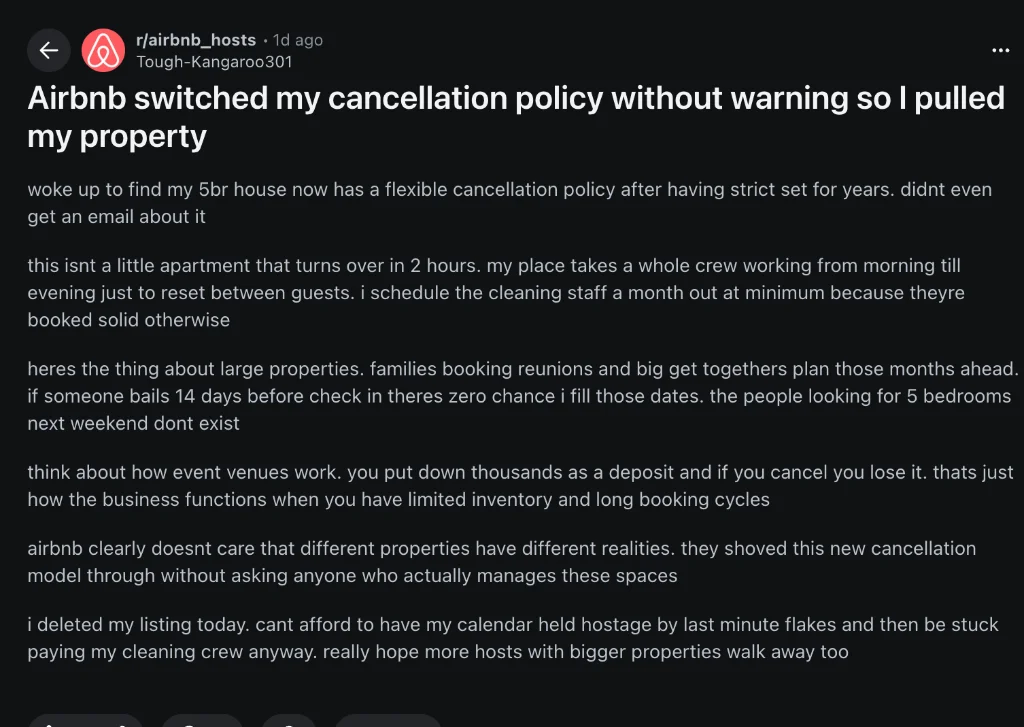
One discussion even asked whether hosts should organise collectively to push for meaningful improvements to the way their concerns were handled (view the Reddit thread on collective hosting concerns). Another thread questioned why a host whose cancellation policy was changed without warning pulled their property off the platform entirely (read the cancellation policy change discussion on Reddit). Looking at those conversations together, it became clear that the problem wasn't simply guest damage or one isolated support ticket. Many hosts were asking for systems that understood the realities of running a hospitality business rather than treating every issue as another customer support case.
Those conversations changed the way we approached building Wayzyy.
Instead of starting with a list of features, we started with a list of questions.
If identity is the foundation of trust, why shouldn't guest verification happen before a booking is confirmed?
When a host has spent years building an outstanding reputation, should one low rating automatically become public without first understanding what actually happened?
If both guests and hosts want a fair outcome during disputes, why shouldn't the platform actively help resolve the issue instead of simply passing messages back and forth?
Finally, if the host is already investing in the property, employing staff, maintaining hospitality standards and carrying the operational risk, does charging a large commission on every successful booking still make sense?
Those questions shaped almost every major decision we made.
Guest verification on Wayzyy begins with DigiLocker-based identity verification, helping establish trust before arrival. Reviews rated three stars or below go through a manual review process so the complete context can be understood before they're published. Whenever disputes arise, our three-layer mitigation framework focuses first on preventing problems, then on mediation and finally on structured evidence-based resolution if required. Instead of relying on a traditional commission model, we chose a recharge-based credit system that allows many hosts to operate at an effective platform cost of around 2–3% as booking volume grows.
Calculate Your True Earning Leak
See how much you lose to Airbnb's 18% fees versus Wayzyy's flat-rate credits.
Traditional commission models charge a flat rate that scales indefinitely with your bookings.
No commission deducted from individual payouts. Unlock booking volumes with simple credits.
₹80,000 / Month
Notice that none of those decisions were made because we wanted to build another booking platform.
Every one of them came directly from listening to hosts.
The more conversations we had, the more obvious it became that independent hosts weren't asking for flashy features.
They wanted a platform that understood what it actually feels like to hand over the keys to your property, welcome complete strangers into your home and trust that someone would be there to support you if things didn't go according to plan.
That's the company we're trying to build.
Not by asking hosts to adapt to another marketplace.
By building a marketplace that finally adapts to the realities of hosting.
Final Thoughts
When we first started looking at the short-term rental industry, we thought the biggest challenge would be helping hosts get more bookings.
The more time we spent speaking with property owners, the more we realised we were asking the wrong question.
Bookings were never the real problem.
Building a business around those bookings was.
Anyone can create a listing.
Anyone can upload professional photographs.
Getting your first reservation is exciting, but that's only the beginning of the journey. The real work starts after guests begin checking in. Every review shapes your reputation, every dispute tests your systems and every expense influences whether the business remains profitable a year from now.
Spend enough time talking to experienced hosts and you'll notice something interesting.
Very few measure success by occupancy alone.
Instead, they talk about repeat guests.
They celebrate five-star experiences.
They invest in better housekeeping.
They renovate rooms before peak season.
They improve Wi-Fi because remote workers asked for it.
They hire better caretakers because hospitality matters more than squeezing every last rupee out of a booking.
That's how sustainable hospitality businesses are built.
The biggest lesson we've learnt is that great hosts don't need another platform that simply lists their property.
They need a partner that understands everything happening behind the scenes.
Support shouldn't only appear when something goes wrong.
Identity verification shouldn't begin after a dispute starts.
Fair review systems shouldn't punish years of consistently good hospitality because of one isolated experience.
Platform pricing shouldn't become more expensive every time a host becomes more successful.
Those aren't marketing ideas.
They're principles we believe the next generation of hospitality platforms should be built around.
That's exactly what we're trying to build with Wayzyy.
A marketplace where hosts retain more of what they earn, guests can book with greater confidence and both sides know that trust, transparency and fairness are part of the platform from the very beginning.
The short-term rental industry is still growing rapidly, especially across India.
More families are choosing vacation homes over hotels.
Longer stays are becoming increasingly common.
Independent hosts now have opportunities that barely existed a decade ago.
At the same time, expectations are also rising.
Guests expect hotel-quality hospitality while still wanting the warmth and comfort of a home. Meeting those expectations requires time, investment and a platform that supports hosts instead of simply charging them for every successful booking.
If you're planning to start your first vacation rental, don't let this article discourage you.
Let it prepare you.
Know your costs before they surprise you.
Build systems before you need them.
Choose partners that help your business grow instead of quietly reducing its margins year after year.
Most importantly, remember that hosting has never been about collecting reservations.
It's about creating experiences people genuinely want to come back to.
Everything else - including the platform you choose - should help make that easier, not harder.
Frequently Asked Questions
Want to list your villa on Wayzyy?
Email us at hello@wayzyy.com - Wayzyy is launching soon in Goa.